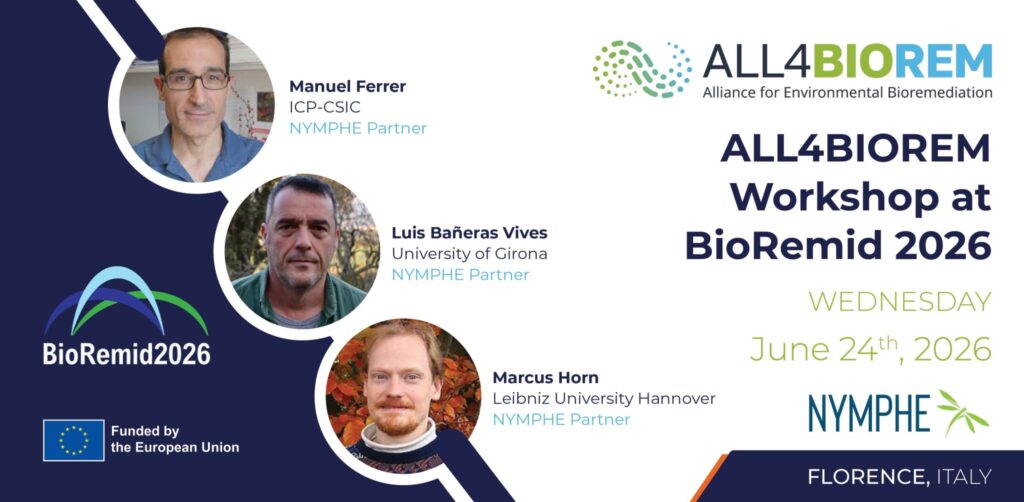
ALL4BIOREM Cluster Workshop at BioRemid 2026 to Showcase Leading European Bioremediation Projects and Research
The ALL4BIOREM Cluster Workshop, taking place on 24 June 2026 during BioRemid 2026 – the 4th International Meeting on New Strategies in Bioremediation and Restoration Processes, will bring together researchers, environmental professionals, policymakers, and stakeholders from across Europe to explore the latest advances in bioremediation, soil health, and ecosystem restoration.
The workshop will serve as a platform for knowledge exchange and collaboration among leading EU-funded projects working to develop innovative and sustainable solutions for environmental remediation. Through a combination of project presentations and scientific talks, participants will gain insight into cutting-edge technologies, nature-based solutions, and multidisciplinary approaches addressing some of today’s most pressing environmental challenges.
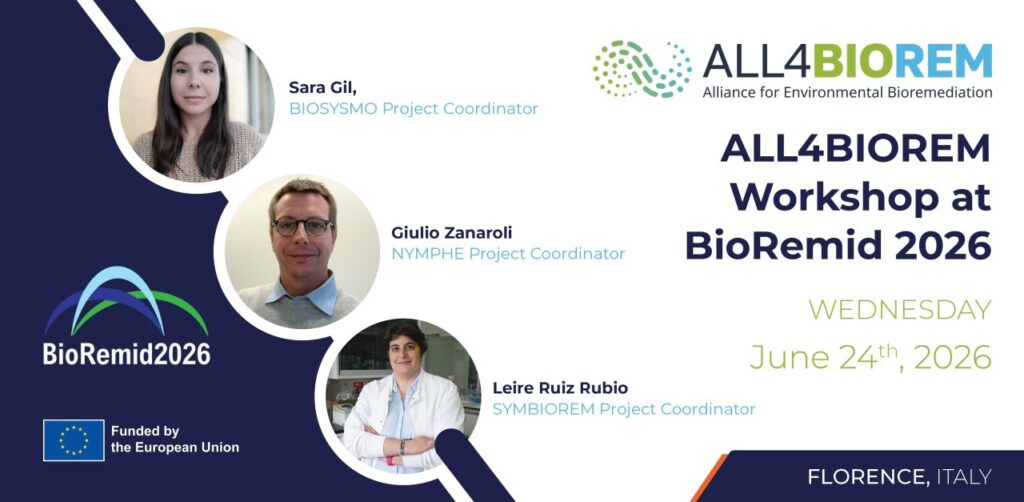
The event will begin with Flash Project Presentations from representatives of key ALL4BIOREM Cluster initiatives:
BIOSYSMO – Sara Gil Guerrero Gil (IDENER.AI)
NYMPHE – Giulio Zanaroli (University of Bologna)
SYMBIOREM – Leire Ruiz Rubio (EHU)
These introductory presentations will provide an overview of the projects’ objectives, achievements, and contributions to sustainable environmental restoration.
The scientific programme will then feature a series of expert presentations covering a wide range of innovative remediation approaches.
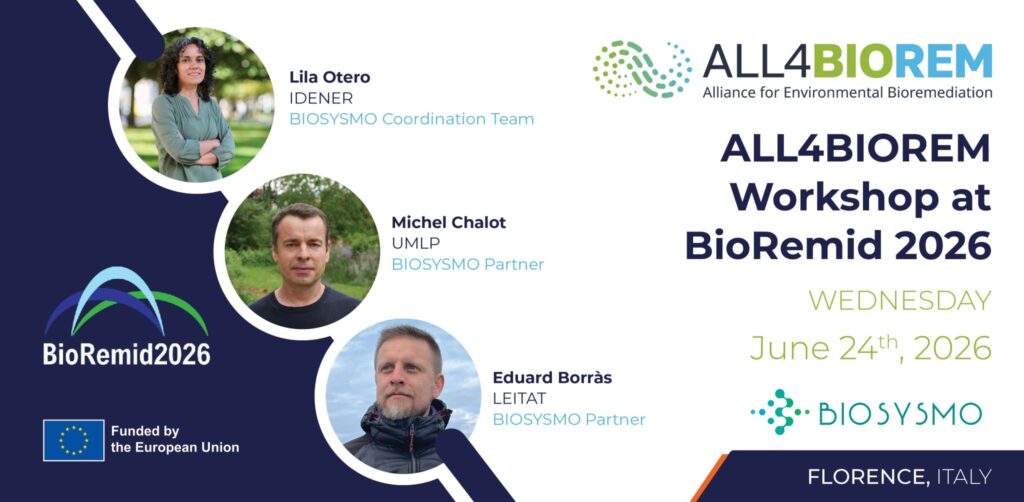
BIOSYSMO Presentations
Lila Otero (IDENER.AI) “A Computational Framework Supporting Biosystem Design” Exploring how advanced modelling and digital tools can support the design and optimisation of bioremediation strategies.
Michel Chalot (Université Marie et Louis Pasteur) “Soil Phytoremediation: From Lab to Field” Presenting the transition of phytoremediation technologies from experimental research to practical field applications for contaminated soil restoration.
Eduard Borràs (Leitat Technological Center) “Scaling-up of Bioelectrochemical Systems (BES) for Groundwater Bioremediation” Highlighting advances in technologies designed to improve groundwater treatment and facilitate large-scale implementation.
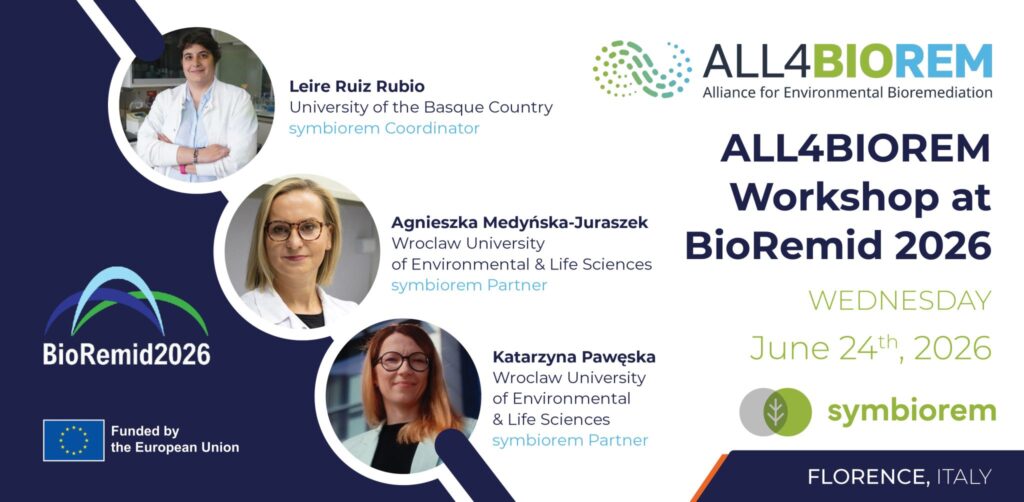
Symbiorem Presentations
Leire Ruiz Rubio (EHU) “Smart Ecobiopile: A Sustainable and Effective Strategy for the Remediation of Heavy Metals and PAHs” Introducing innovative remediation techniques for tackling contamination by heavy metals and polycyclic aromatic hydrocarbons.
Agnieszka Medyńska-Juraszek (Wroclaw University of Environmental and Life Sciences) “Assisted Soil Remediation – Challenges in Multi-Contaminated Soils” Discussing the complexities of remediating soils affected by multiple pollutants and current strategies to improve remediation performance.
Katarzyna Pawęska (Wroclaw University of Environmental and Life Sciences) “Floating Treatment Wetlands as a Nature-Based Solution for Water Treatment” Presenting sustainable water treatment systems that harness natural processes to improve water quality and ecosystem health.
NYMPHE Presentations
Manuel Ferrer (ICP-CSIC) “AI-Reprogrammed Biological Systems for the Degradation of Recalcitrant Pollutants (Microplastics)” Demonstrating how artificial intelligence and biotechnology can be combined to develop biological systems capable of degrading persistent contaminants.
Luis Bañeras Vives (University of Girona) “Tuning an Electric Plastic Breakdown Symphony: The Fenton Overture, the Microbe Finale” Showcasing innovative approaches that integrate electrochemical and biological processes for enhanced plastic degradation.
Marcus Horn (Leibniz Universität Hannover) “Eco-Boost: Accelerating River Sediment Purification from Pharmaceuticals with Bioaugmentation” Presenting bioaugmentation strategies aimed at improving the removal of pharmaceutical contaminants from river sediments.
Together, these presentations reflect the diversity and scientific excellence of the ALL4BIOREM Cluster, covering topics ranging from computational biosystem design and phytoremediation to artificial intelligence, microplastic degradation, bioelectrochemical systems, and nature-based water treatment solutions.
The workshop will provide a unique opportunity to discover how European research projects are advancing innovative, scalable, and sustainable approaches to environmental restoration while strengthening collaboration across the bioremediation community.
The morning session will conclude with a dedicated round table discussion, providing an opportunity for representatives from participating ALL4BIOREM Cluster projects to exchange perspectives, reflect on key findings presented throughout the session, and discuss future collaboration opportunities. The discussion will focus on how European research initiatives can continue to work together to accelerate the development and deployment of effective bioremediation strategies and support long-term environmental restoration goals.
The round table will be moderated by Concepción Calvo and Elisabet Aranda from the University of Granada and members of the BioRemid 2026 Organising Committee, who will guide the conversation and facilitate interaction among speakers and participants.
By bringing together experts from different disciplines and projects, the ALL4BIOREM Cluster Workshop aims to strengthen collaboration across the European bioremediation community, promote knowledge exchange, and highlight innovative solutions that can help address some of today’s most pressing environmental challenges.
For researchers, practitioners, policymakers, and stakeholders interested in environmental restoration, the workshop represents an excellent opportunity to discover the latest scientific developments and contribute to discussions shaping the future of sustainable remediation.